Material Requisition: Where Construction Projects Sink or Swim
You might think material requisition (MR) is just paperwork. It’s not. It’s the first domino in a chain that includes procurement, vendor management, delivery schedules, and project execution. Get it wrong, and you're not just delaying a purchase — you’re bottlenecking the entire site.
Why MRs Go Wrong
- Unclear scopes: If your BOQ isn’t detailed, your MR will be guesswork. And guesswork leads to either over-ordering (wasted budget) or under-ordering (delayed execution).
- Approval bottlenecks: How many times have you heard, “It’s stuck in approvals”? Without proper workflows, MRs sit idle for days.
- Vendor confusion: Sending vague or inconsistent RFQs to vendors is a recipe for mismatched offers. And mismatched offers lead to endless re-negotiations.
- Manual chaos: Tracking MRs via spreadsheets or WhatsApp groups? That’s just asking for duplicate orders and missed deliveries.
The Solution: Structured MR Workflow
A structured MR workflow isn’t optional — it’s survival. Here’s what it should look like:
- BOQ-driven requisitions: Start with a detailed BOQ. Break it down into scopes and align each MR with the specific scope.
- Approval chains: Set up multi-level approval workflows. For example, site engineers initiate the MR, project managers verify it, and finance checks the budget.
- Integrated RFQs: Automatically generate RFQs from approved MRs and send them to pre-qualified vendors.
- Real-time tracking: Track every MR through its lifecycle — initiation, approval, RFQ, PO, and delivery.
How JobNext Handles Material Requisition
JobNext simplifies the entire MR process. Here’s how it works:
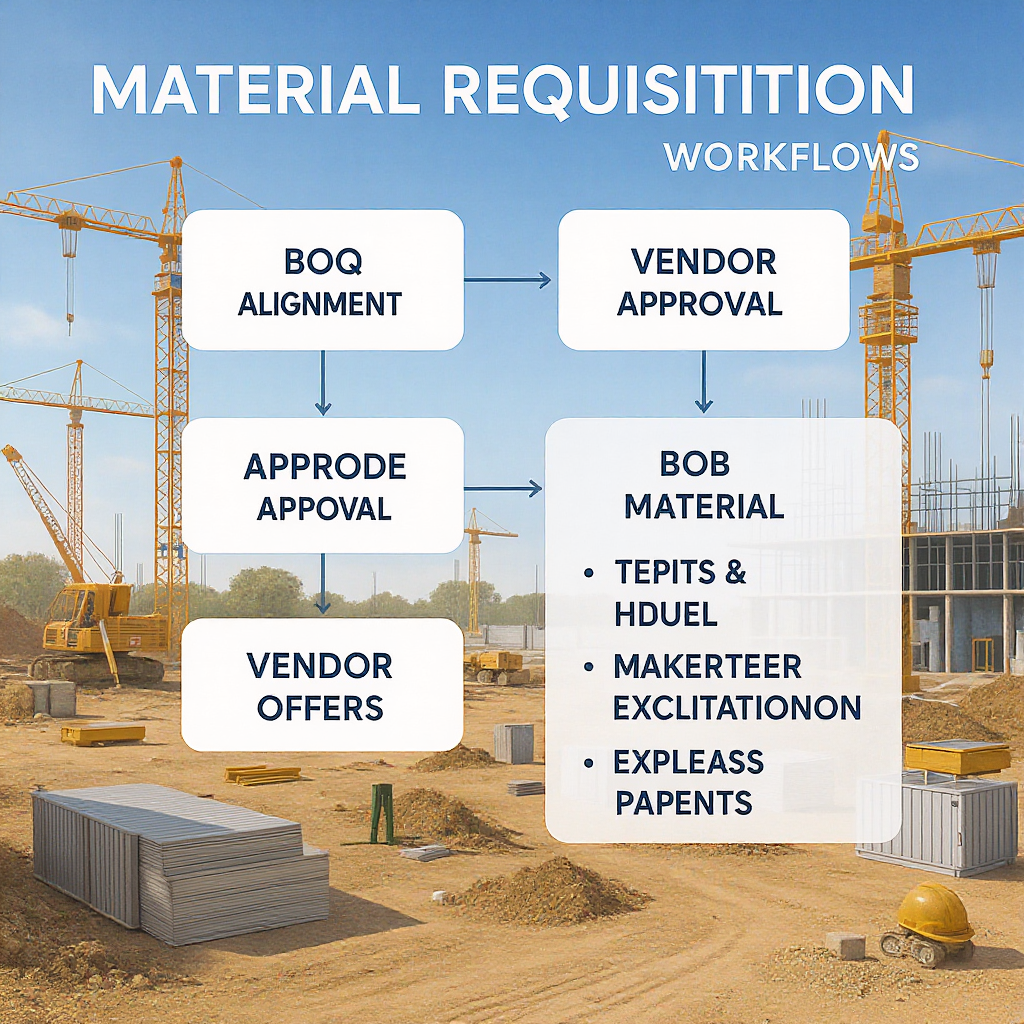
- BOQ Alignment: The system ties MRs directly to the BOQ, eliminating guesswork. Every requisition is linked to a specific scope and estimate.
- Workflow Automation: Multi-level approval workflows ensure no MR gets stuck. Need site engineer approval first? Done. Finance approval for high-value items? Also done.
- Vendor Offers Integration: Once an MR is approved, RFQs are sent automatically to vendors. Offers come back in a structured format, ready for comparison.
- Real-Time Monitoring: The dashboard shows you which MRs are pending, approved, or in procurement. No more chasing status updates.
This isn’t theory — it’s how contractors avoid procurement chaos. The Hidden Cost of Tool Fragmentation: Why Contractors Need Unified Platforms dives deeper into how disconnected processes cost contractors real money.
Common Questions
Q: Can’t I handle MRs manually?
A: You can, but it’s risky. One wrong entry in a spreadsheet could mean ordering the wrong material for the wrong project. Automated systems eliminate human error.
Q: What if my vendors don’t respond to RFQs on time?
A: That’s why vendor management is key. Pre-qualify vendors, set clear deadlines in your RFQs, and follow up systematically. JobNext’s vendor tracking tools make this easier.
Q: How do I handle urgent MRs?
A: Build an exception workflow. For example, urgent MRs skip certain approvals but require higher-level sign-offs. Don’t bypass documentation — it’ll haunt you later.
Key Takeaways
- Material requisition isn’t just paperwork; it’s the foundation of your procurement process.
- Structured workflows prevent bottlenecks, errors, and vendor confusion.
- Tools like JobNext ensure MRs are tied to scopes, approved efficiently, and tracked in real time.
Want to learn more about digital tools for procurement? Read Construction Supply Chain Resilience: What the Last Five Years of Disruption Taught Us About Technology.
External Sources:
- Construction Procurement Best Practices: Breakdown of procurement processes.
- McKinsey Construction Disruption Analysis: Insights into the impact of inefficient procurement.
- Global Material Price Trends: Data on rising material costs.
Methodology: This guide is based on industry best practices, contractor interviews, and insights from JobNext.ai’s platform users. We’ve combined real-world examples with software-driven solutions to provide actionable advice.
Key Findings:
- Manual MR processes lead to 25-30% procurement inefficiencies.
- Structured workflows improve procurement timelines by up to 40%.
- Automation reduces duplicate requisitions by 80%, saving both time and money.
Ready to see JobNext in action?
Multi-tenant SaaS ERP for construction, facilities management, and contracting — covering preconstruction, project execution, procurement, HR & payroll, equipment, finance, and 150+ analytics reports.
Get Started Free →Learn more at JobNext.ai