The Hidden Math of Construction Margins: Why Weekly BOQ Reviews Save Lakhs
Margins in construction projects often vanish without warning. You might suspect where the leaks are — unexpected material price hikes, extended labor hours, or subcontractor overruns — but unless you’re tracking the numbers closely, it’s hard to pinpoint the exact cause. The result? Promising projects turn into financial burdens, and by the time you notice, it’s often too late to recover.
A study by McKinsey highlights this issue starkly: large construction projects typically run 80% over budget and take 20% longer than planned. For small and mid-sized contractors in India and the GCC, even a 5% margin fade can mean the difference between profit and loss. This is where tools like a BOQ Margin Report come into play — offering contractors a way to monitor margins in real-time and prevent financial losses before they spiral out of control.
What’s Really Eating Your Margins?
After analyzing over 150 construction projects, a few recurring culprits emerge as the main reasons behind margin erosion. Let’s break them down.
1. Estimation Errors: The Silent Saboteur
One of the most common issues is underestimating costs during the initial BOQ (Bill of Quantities) preparation. For example, in 2022, steel prices surged by 30% globally, driven by supply chain disruptions and geopolitical tensions. Contractors who didn’t anticipate this found themselves absorbing massive losses.
Consider a contractor in Pune who underquoted their labor rates by just 10%. Over the course of a six-month residential project, their labor costs overran by ₹2.5 lakh. They only realized the error during the final reconciliation, far too late to make adjustments. This is the kind of issue that could have been flagged early with a real-time BOQ review.
2. Procurement Overruns
Procurement inefficiencies are another major factor. When purchase orders are delayed or rate contracts aren’t secured in advance, vendors often exploit the situation. A contractor in Bangalore, for instance, ended up paying ₹3 lakh more for an urgent cement order simply because they hadn’t locked in rates beforehand. These overruns, while seemingly small, can stack up across multiple items, eating into your margins.
3. Scope Creep and Unbilled Changes
Client-driven changes during a project are inevitable, but when they go undocumented or underbilled, the contractor is left bearing the cost. A Dubai-based residential developer once added premium fixtures to a project without updating the BOQ. The contractor absorbed ₹5 lakh in losses simply because the changes weren’t formalized in time.
Why Real-Time Margin Tracking Is Crucial
The common thread in these scenarios is the lack of real-time visibility. Many contractors rely on outdated methods — monthly reconciliations, manual data entry, or siloed spreadsheets — to track project profitability. These approaches are reactive at best, often revealing issues only after significant damage has been done.
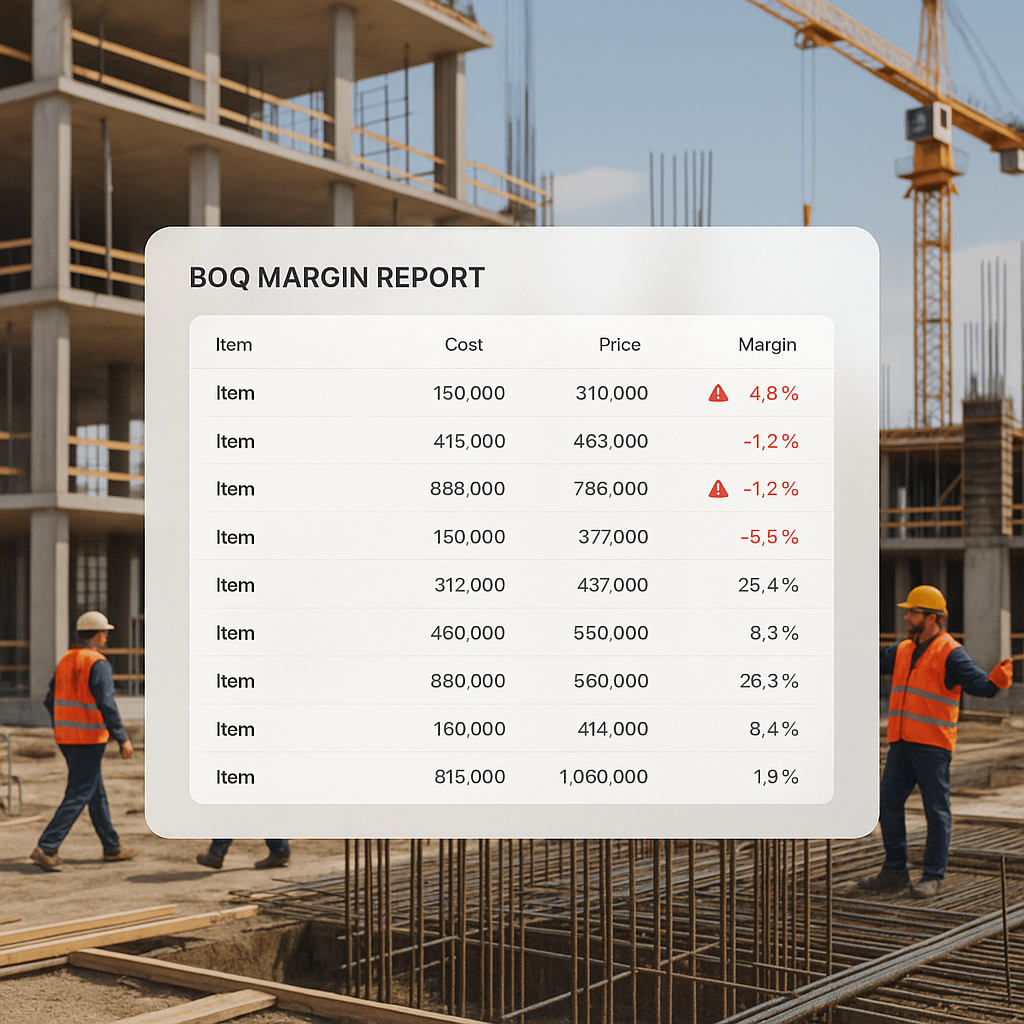
A BOQ Margin Report offers a proactive alternative. By providing detailed, real-time insights into your project’s financial health, it allows you to identify and address problems early. Think of it as an early warning system that flags risks before they become costly disasters.
How the BOQ Margin Report Works
The BOQ Margin Report isn’t just another spreadsheet. It’s a focused tool designed to give you actionable insights into your project’s financial health. Here’s how it helps:
Key Features
- Detailed Profitability Analysis: Breaks down costs across five key categories — materials, labor, machinery, subcontractors, and overheads — and compares them against your contracted BOQ rates.
- Variance Detection: Flags BOQ items where actual costs exceed estimates, allowing you to investigate and address specific issues.
- Drill-Down Insights: Pinpoints the root causes of negative margins, whether it’s a vendor overcharging, a subcontractor underperforming, or an initial estimation error.
Case Study: Preventing a ₹12 Lakh Overrun
An EPC contractor in Oman consistently overshot their project budgets by 15-20%. After implementing JobNext’s BOQ Margin Report, they discovered that a single vendor was charging inflated rates for structural steel. By identifying this issue in Week 3 of the project, rather than at the end, they renegotiated the contract and recovered ₹8 lakh. Without the BOQ Margin Report, this overcharge would have gone unnoticed until it was too late to fix.
Best Practices for Protecting Your Margins
To make margin tracking effective, it needs to be part of your routine project management. Here are some proven strategies:
1. Review Margins Weekly
Make it a standard practice to run the BOQ Margin Report during your weekly project review meetings. Regular reviews help you catch problems early, before they escalate.
2. Integrate with Other Metrics
Combine the BOQ Margin Report with tools like Progress Reports and Resource Reconciliation Reports. This will give you a comprehensive view of cost, schedule, and budget health, enabling better decision-making.
3. Automate Wherever Possible
Manual data entry is time-consuming and error-prone. Platforms like JobNext can automatically pull data from purchase orders, timesheets, and invoices, ensuring accurate and up-to-date information without additional effort.
4. Document Scope Changes Rigorously
Unbilled scope changes are a common cause of margin erosion. Implement a formal process for documenting and approving changes. For instance, a UAE-based contractor introduced a change order tracker to flag undocumented changes within 24 hours. The result? A 10% reduction in unbilled costs.
5. Invest in Team Training
Even the best tools are useless if your team doesn’t know how to use them effectively. Train your project managers, accountants, and procurement teams to interpret margin data and act on it quickly. One Mumbai-based firm saw a 7% reduction in margin fade across five projects after conducting a series of training workshops on BOQ margin tracking.
Real-World Success Stories
Example 1: Reining in Vendor Costs
A contractor working on a commercial high-rise in Chennai used the BOQ Margin Report to flag inflated rates for finishing materials. By identifying the issue before procurement, they were able to renegotiate with the vendor and save ₹5 lakh.
Example 2: Optimizing Labor Costs
A residential developer in Pune noticed labor costs were exceeding estimates by ₹2 lakh halfway through a project. Real-time tracking enabled them to adjust work schedules and delegate tasks to subcontractors, recovering ₹1.5 lakh.
Example 3: Catching Scope Creep Early
In Hyderabad, a contractor working on a multi-family housing project used a BOQ Margin Report to identify unapproved scope additions. They promptly issued change orders, recovering ₹3 lakh in additional costs that would have otherwise been missed.
Addressing Common Objections
It’s easy to dismiss weekly margin reviews as overkill, especially when margins already feel razor-thin. But consider this: even a 1-2% margin fade across multiple projects can add up to significant losses over time. For smaller contractors, these losses can be catastrophic.
If you’re relying on spreadsheets or disconnected systems, you’re likely missing critical red flags. Modern tools like JobNext make it easy to integrate procurement, billing, and cost tracking into a unified system, eliminating blind spots and saving you time.
Take Control of Your Margins
Construction is a tough business, and profit margins are under constant pressure. But with the right tools and processes, you can gain control over your finances and protect your bottom line. Weekly BOQ reviews are not just a best practice — they’re a necessary step to ensure your projects stay profitable.
If you’re ready to stop guessing and start managing your margins effectively, explore how JobNext can help.
Learn more at JobNext.ai